TEDx at Carrollwood Day School:
Risk-Takers in Action
Real growth begins when comfort ends. On the TEDx stage, student risk-takers shared bold ideas and personal stories that challenged assumptions and sparked meaningful change.
Ideas have the power to challenge. They can inspire and quietly reshape the way we see the world. That belief sits at the heart of TED, Technology, Entertainment, and Design, which was founded in the spirit of ideas worth spreading. TEDx carries that same mission forward, creating spaces where speakers and audiences engage in something more meaningful than a presentation. A TED talk is a conversation, an exchange of perspectives that invites listeners not only to hear a message, but to reflect on it, question it, and carry it beyond the room. At Carrollwood Day School, TEDx lives naturally within our school culture. CDS students are encouraged to broaden their thinking, lean into curiosity, explore ideas that matter - and share them with the world.
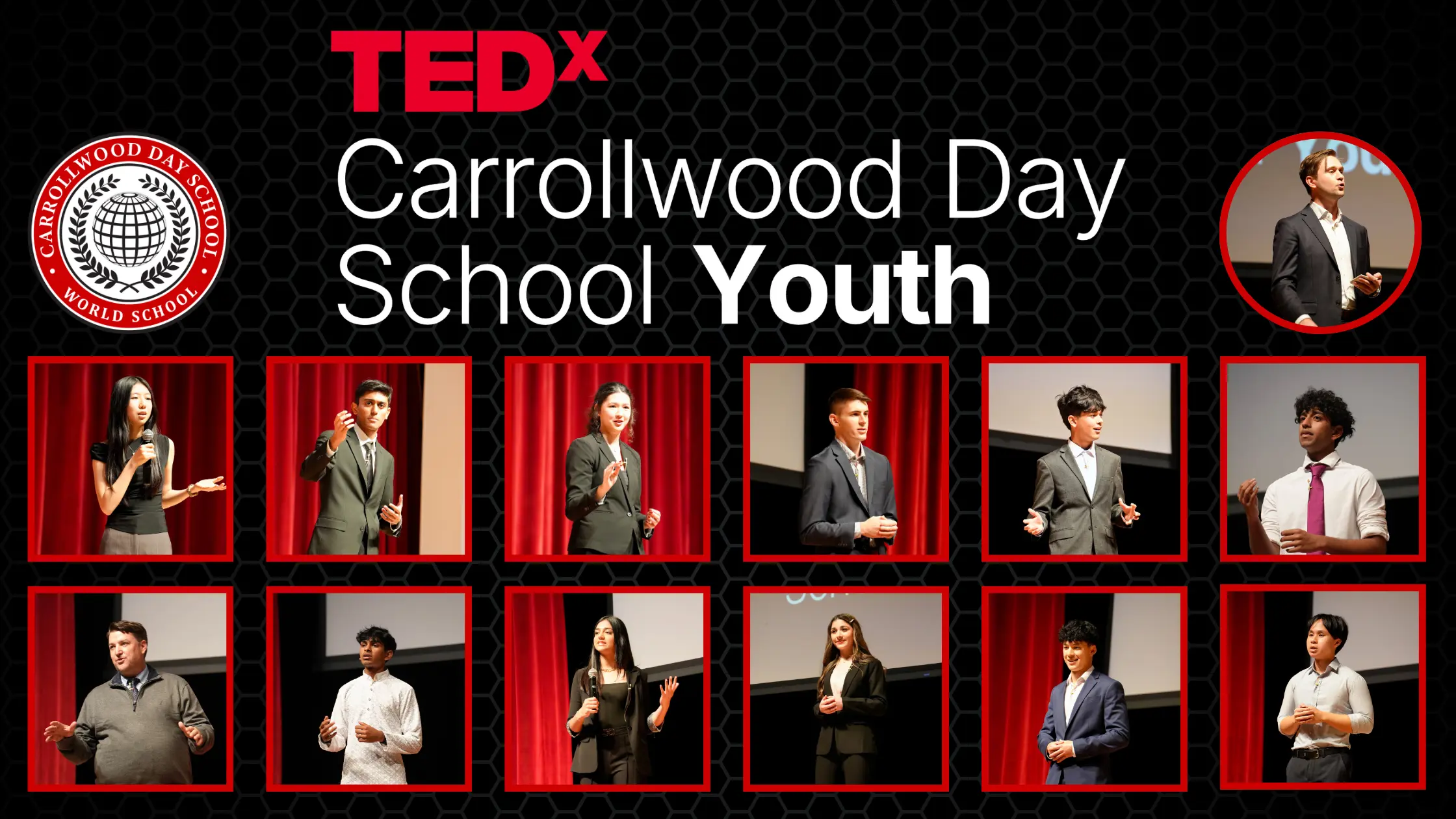
On January 15, Carrollwood Day School’s TEDx stage came alive once again under the theme Risk-Takers. Throughout the evening, speakers shared lived experiences that reflected the courage it takes to speak honestly, step forward, and try something new, even when the outcome is uncertain. Their stories inspired the audience to listen closely, think deeply, and begin imagining solutions to challenges in our world, our community, and our everyday lives. With the support of dedicated student mentors, faculty, and staff, and thanks to the leadership of Ms. Westfall and Ms. McCartney, the night became more than a series of talks. It became a shared moment of dialogue, reflection, and growth, reminding us that meaningful change often begins with the willingness to take a risk.
Together, these voices reminded us that risk has the power to transform not only individual paths, but the communities we shape and the conversations we carry forward. We saw how taking a chance can lead to new ways of thinking and learning, redefine what success looks like, and build deeper understanding between people. While choosing to take a risk does not promise an easy or predictable outcome, it does create momentum. It invites connection, reflection, and progress. As we leave this experience, may we carry these stories with us as a reminder that growth begins the moment we choose courage over comfort, and that who we become is often shaped by the risks we are willing to take.
View photos of TEDx Carrollwood Day School HERE.
Speaker Summaries and Speech Links
Spencer Peek, Class of 2016 - Keynote Speaker
The night began with keynote speaker Spencer Peek, Class of 2016, returning to the very stage where he first spoke as a junior eleven years ago at the inaugural TEDx CDS event. Then, Spencer shared a powerful message about navigating unexpected change and the emotional and psychological work required to move through adversity. Now, more than a decade later, his return felt both grounding and inspiring, underscoring just how far student voices can travel. Spencer’s story mirrored the theme of the evening, shaped by risk and resilience, as he reinforced that growth often comes from persistence rather than singular breakthroughs. He welcomed the audience to rethink what progress really looks like, offering the perspective that forward movement is often built quietly over time. As he shared, “Progress doesn’t come from big moments, it comes from consistency.”
Alyssa Chen, '27 - The Power to Pivot
Alyssa Chen’s message resonated deeply with anyone who has ever felt boxed in by expectations or afraid to change course. Reflecting on her journey from being labeled a “gifted child” to confronting failure, self doubt, and shifting interests, Alyssa spoke candidly about how easy it is to close doors too early, especially when success feels uncertain. From doubting her place in STEM after struggling in middle school, to pivoting from humanities and business back toward science, she shared how growth often comes not from certainty, but from curiosity and flexibility. Her experiences, including moments of public failure and later rediscovery of confidence in biology, underscored a powerful truth. We are not confined to where we begin, only by the doors we choose to shut before giving ourselves room to explore.
As her talk unfolded, Alyssa expanded the idea of pivoting beyond academics, touching on mindset, adaptability, and the courage it takes to embrace change. Whether it was reframing failure as feedback, placing many bets through trial and error, or making the deeply personal decision to step back from a decade long commitment to violin, she showed that change does not erase identity, it deepens it. Even when pivots are difficult and emotional, they can open space for growth, balance, and new possibilities. As Alyssa powerfully affirmed, “No matter how much you change or what form your decision takes, know that you always have the power to pivot.” Her words left the audience with permission to evolve, reminding them that progress is rarely linear, and that choosing a new direction can be an act of strength, not surrender.
Nishant Shah, '27 - Leadership is an Action: Why Anyone Can Lead
Nishant Shah’s talk challenged the familiar image of leadership and replaced it with something far more human. He began by naming a belief many of us carry, that leaders are born, not made, before gently unraveling it. For years, Nishant imagined leadership as something reserved for people with titles, platforms, and legacies, those who stand at the front of the room and are remembered long after they are gone. Over time, that image no longer fit. The moment that reshaped his understanding came from his elementary school principal, Dr. Schwarzmann, who noticed a quiet second grader sitting alone on the rug, sat beside him, learned his name, and continued to ask, every time she saw him, “How are you, Nishant?” Through those small, consistent acts, she showed him that leadership lives in everyday moments. As Nishant explained, when someone sees a need and takes action, “that is leadership.”
Because of Dr. Schwarzmann, Nishant redefined his view on leadership as empathy followed by action. Leadership, he reminded the audience, is not a position to be earned but a responsibility we choose to take on, again and again. He challenged the myth that only extraordinary people shape the world, offering instead a simple and powerful truth: "leadership is about being what a situation needs at the moment.” Whether it shows up in bold decisions or quiet acts of care, leadership begins when we are willing to act. His message left the audience reflecting on how even the smallest choices can create lasting impact, and how each of us has the ability to lead, starting exactly where we are.
Lilly Jim, '28 - The Hidden Curriculum of Musical Excellence
Lilly Jim invited the audience to pause and reconsider something often taken for granted: the role of music in education. With both passion and clarity, she challenged the idea that music is merely an extracurricular, instead presenting it as a powerful foundation for focus and discipline, the very skills schools work so hard to cultivate and that support achievement across every subject. Drawing from her own experience as a multi-instrumentalist, Lilly shared how music taught her to sit with discomfort, embrace failure, and keep showing up even when progress felt slow. Supported by research and brought to life through stories from her own students, she made a compelling case that music education shapes not just better musicians, but stronger learners and more confident people. As she reflected, “Music didn’t just teach me how to play, it taught me how to learn,” reinforcing her belief that music should not be “seen as something extra, but something essential.” She reminded the audience that “music fosters creativity, belonging, and confidence—three things every successful classroom, and every thriving student, needs.”
“That is why music matters. It builds creative, confident students who are not just prepared to memorize facts for a test, but who are ready to think deeply, take risks, and bring their unique ideas into the world. And in the end, isn’t that what education is truly about?"
Cash Coppins, '26 - More Than a Game: The Business Behind Soccer's Rise in North America
Cash Coppins took the audience on a journey beneath the surface of soccer, opening with a vivid metaphor: while everyone sees the bright bloom of a flower, the real life happens in the roots, where commitment and growth are nurtured. For Cash, those roots have been cultivated through a lifelong dedication to soccer. He explored how this personal commitment mirrors what the sport can offer communities, contrasting soccer’s growing popularity in North America with the fragile, often exclusionary systems that support it at the youth, collegiate, and professional levels.
Cash highlighted how the sport unites people worldwide, yet in North America, he argued, the focus has shifted toward monetization and spectacle, “the bloom,” while the roots of accessibility, local development, and community engagement are neglected. Pay-to-play youth leagues, fragmented systems, and limited pathways for domestic talent weaken the foundation, and even collegiate and professional structures prioritize business stability over communal belonging. Cash challenged the audience to rethink what we value in the game: not just flashy success or market share, but the deep, structural roots that create authentic engagement and opportunity. “We need to stop chasing the biggest market share and start chasing the deepest, most authentic community.”
Gabriel Lopez, '27 - Un-American: Rethinking Identity through Shared Humanity
Gabriel Lopez challenged the audience to rethink identity and belonging in a world quick to sort people into categories. Opening with his own experience navigating the gray space between boxes on forms—too Hispanic to feel fully American, too “gringo” to feel fully Nicaraguan—Gabriel illustrated the tension of living between labels and the isolation it can create. He argued that these rigid distinctions don’t just fail to capture who we are, they actively harden divisions, building emotional walls that separate “us” from “them.” Drawing from research on human behavior and societal polarization, he explained that our brains are wired to favor those we see as part of our group, leaving outsiders vulnerable to misjudgment and fear.
Gabriel brought his ideas to life through action, sharing his volunteer work with the Hispanic Services Council. Mentoring students and families, he saw firsthand how labels can obscure the humanity behind a person’s story. Gabriel encouraged the audience to take small, deliberate steps to challenge assumptions, from tutoring a student to sitting with someone’s silence, insisting that these gestures rebuild trust and connection. He left the audience with a powerful message that every time we do that, “we pull one person out of the 'them' bucket, and place them exactly where they’ve always belonged: with 'us.'"
Simmon Chauhan, '26 - Flow
Simmon Chauhan drew the audience into a moment of stillness, beginning with a childhood choice that quietly shaped his life. When his mother introduced him to Bhangra, it was more than learning a dance, it was a way back to his roots, a connection to culture, and eventually a doorway into something deeper. What started as movement became a state of mind, one that taught him how to quiet the world and fully inhabit the present. He described a defining moment at his first out-of-state competition in Boston, standing under bright lights with his heart racing as the music began. Then everything went blank. Not empty, but suspended. In that space, he wasn’t thinking about steps or judges or expectations. He wasn’t performing. He was simply being. “The moment you stop trying to be someone, is the moment you finally are someone,” he reflected, capturing the power transforming presence into peace.
Simmon explored the paradox of performance, explaining that while dancing is outwardly visible, it is where he feels most free from ego and pressure. In a world obsessed with being seen, he found meaning in disappearing, and he connected this experience to a reality we all live in, one filled with constant notifications, deadlines, and noise that masquerades as urgency. Years later, he learned that this experience had a name: flow, a state where challenge and skill align so completely that time bends and self-consciousness fades. He reminded the audience that flow doesn’t require a specific activity, what matters is fully showing up, being absorbed, and letting the world fade away. Dance gave him his doorway. Flow gave him his life back.
Mr. Bryan McGrath, Lower School Design Teacher - Return to a Happy Place
Lower School Design Teacher, Bryan McGrath, created a space for the audience to consider how modern life has polluted, shallowed, and isolated the spaces where human connection once thrived. He warned that constant digital engagement is robbing us of real experiences, opportunities to explore, play, interact, and even get frustrated. He emphasized that rebuilding these essential skills begins by returning to the physical spaces that foster connection—the sandbox, the park, the library—where relationships, learning, and memory are shaped.
He offered three ways to restore what has been lost. “Be present by giving presence,” he suggested. First, return to nature. Visit trails, riverwalks, and parks, where the experience itself matters more than the signal strength. Second, reclaim quality time, truly showing up whether at the table, in carline, or other everyday spaces. Third, stay mindful of the toxins, the distraction, isolation, and shallow interaction that infiltrate daily life. Mr. M reminded the audience that technology isn’t the enemy, but how we use it can either strengthen or erode human connection. By revisiting physical spaces, embracing nature, and prioritizing presence, we are challenged to reclaim connection and joy. “If we can get back to sharing physical space…then maybe, just maybe, we can return to a happier place.”
Aadi Patel, '27 - Finding Your Stage
Aadi Patel shared how performing Indian street plays shaped his life by connecting him to community, culture, and self. Reflecting on his own journey from audience member to performer, Aadi described how these plays created a vibrant network of people united by devotion, collaboration, and shared purpose. “We weren’t performing to an audience. We were creating a moment with them, affecting each and every one of them in their own unique way,” he said, recalling the impact of watching a young boy engage deeply with the play’s messages. Through hours of rehearsal and performance, Aadi discovered the power of relationships across generations and backgrounds, experiencing firsthand how a shared passion can forge understanding and belonging.
Beyond community, Aadi explained that street plays shaped his moral compass and taught him the value of lived experience. Stepping into the lives of the characters he portrayed, he explored ethics, empathy, and consequence in a safe yet profoundly real way. Performing was a vehicle for expression that gave him his identity. For Aadi, the street play became a stage for growth. He urged the audience to find their own version of this stage, whether through art, athletics, volunteering, or any pursuit that brings purpose and expression into the world, reminding them, “Find the thing that connects you to a community, develops your moral compass, and lets you show the world who you are. Let that be your street play.”
Tahi Patel, '28 - The Silent Conversation Between Burnout and Your Nervous System
Tahi Patel shared a deeply personal account of how burnout revealed the hidden conversations between her body and mind. Through her experiences on the volleyball court and in daily life, Tahi explained that burnout isn’t just tiredness, it’s when your body, mind, and motivation fail simultaneously, often silently building up until it forces you to stop. Reflecting on the moment she fainted at home, she said, “If you won’t slow down on your own… I’ll do it for you,” illustrating how her nervous system became the ultimate warning system when she ignored signs of exhaustion. Tahi highlighted that burnout can appear differently for everyone, from missed plays on the field to the pressure of constant academic achievement, and that ignoring these signals only deepens its impact.
She urged the audience to recognize the importance of listening to their bodies and responding to early warning signs before they escalate. Simple actions like prioritizing rest, proper nutrition, and hydration are essential, not indulgences. “Your body is your own personal Zazu,” she said, likening it to the ever-watchful character in The Lion King, constantly alerting you to danger. Tahi’s message went beyond personal anecdotes, emphasizing that true success is not measured by how much you can push through, but by how well you respect and care for the vessel that carries you. Burnout is silent but powerful, and the first step to lasting achievement is realizing that “real success begins when you stop surviving and start healing.”
Alina Knisley, '28 - Achieving Success Through Unique Perspectives
Alina Knisley asked the audience to rethink what success really means to them. Using the metaphor of a race, she reflected on how society often measures achievement by speed, recognition, and comparison, a mindset amplified in schools and online. But Alina’s perspective changed as she watched her younger sister navigate life with Morquio 4A Syndrome, a rare genetic disorder affecting her bones and strength. Her sister’s journey taught her that true success isn’t about crossing the finish line first, it’s about perseverance, purpose, and progress. Alina explained, “Maybe success was never meant to be a competitive sprint at all. Maybe it is a lifelong marathon of courage, one where every step, no matter how small, moves us closer to who we’re meant to be.”
Through her sister’s resilience, Alina saw that success comes from the quiet victories, the small steps, and the courage to keep going when the path is uphill. She emphasized that success is personal, not comparative: it’s measured by persistence, humility, and the courage to keep moving forward. By redefining success as progression rather than perfection, she encouraged others to stop judging themselves by others’ standards and instead honor their own journey. Whether sprinting, walking, or taking one step at a time, Alina reminded everyone, the race isn’t about speed, it’s about the heart to finish it and the lessons learned along the way. “The next time you find yourself comparing your pace to someone else’s, remember this: we are all running a different race. Some paths are smooth, some are steep, and some require you to slow down and breathe. What matters most is not how fast you go, but that you keep moving forward.”
Noah Ozer, '26 - Redefining the Lines That Divide Us
Noah Ozer challenged the audience to rethink what it means to be a global citizen. Many imagine global citizenship as traveling the world, speaking multiple languages, or collecting passport stamps. Noah argued that it’s really about mindset, not miles. He shared a personal moment at CDS’s Lunar New Year Festival, where seeing his Malaysian-Chinese heritage celebrated sparked a realization: you don’t need to leave your hometown to make a global impact. Global citizenship is about curiosity, empathy, and engagement. As Noah said, “If global citizenship is really about your mindset, then the next question is where do those mindsets come from?” From volunteering locally to learning about other cultures in school, anyone can practice global citizenship by opening their mind and taking small, intentional actions.
Noah also emphasized the ripple effect of these choices. Just as children absorb habits and mindsets from those around them, they can also adopt empathy, inclusion, and curiosity. By modeling open-mindedness and challenging our own assumptions, we can create communities that cultivate understanding across divides. In a world where social and racial divisions are magnified by media and politics, this awareness matters more than ever. “Global citizenship isn’t defined by traveling, but by perspective,” Noah shares, as he encouraged the audience to start locally by connecting with neighbors, supporting ethical causes, and fostering curiosity—and reminded them that “Anyone can be a global citizen. The question is: will you choose to be one?”
Eric Tran, '26 - Our Brain’s Hidden Dimension
Eric Tran introduced the audience to a hidden dimension of the human brain: its visual-spatial power. Born in Vietnam, Eric began training on the abacus at age seven, learning not just math but a new way of seeing numbers. Through years of practice, competitions, and televised performances on Super Brain Vietnam, he transformed abstract calculations into mental images, enabling feats like adding 20 three-digit numbers in half a second and dividing 30-digit numbers by 26-digit numbers in his head. “I’m not a human calculator. I don’t have some rare genetic gift. I can do this because when I was seven, someone taught me to see numbers differently,” he explained, showing that our brains can be trained to think in entirely new ways.
Eric then expanded on how this visual-spatial thinking goes beyond numbers with the memory palace technique, which links information to vivid mental images in familiar spaces. By creating a journey through a home or classroom, even complex data like a 1,000-digit number or a long shopping list becomes easy to recall. He emphasized that this ability taps into an evolutionary strength: spatial memory, a skill humans developed for survival. Eric concluded with a powerful message: most of us never fully access this dimension of our brains, but it’s always there. “Don’t accept that you’re ‘bad at math’ or ‘can’t remember things.’ Your brain has this visual dimension…you just have to learn to see it.”