CDS Student Amari Smith Turns Adversity Into Opportunity
What if a different perspective could turn a setback into an opportunity? Carrollwood Day School junior Amari Smith explores that idea in his debut book, Transmuting Adversity Into Opportunity. In a conversation about his book, Amari demonstrates how naturally he applies these principles to real life, offering a powerful reminder that sometimes, changing the way we see a challenge can change what comes next.
By Sarah Winseman
Communications Coordinator
Carrollwood Day School
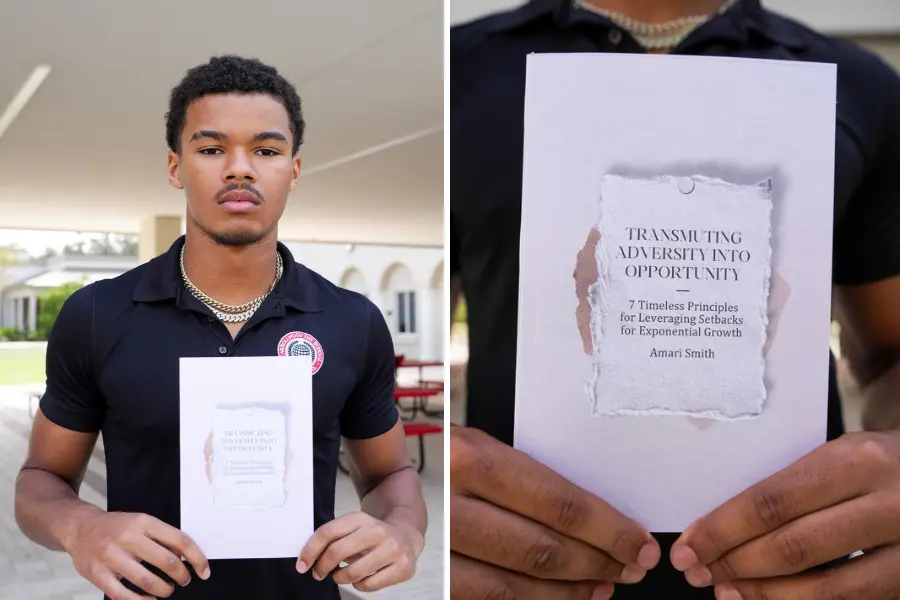
Some conversations leave you thinking differently long after they end. My conversation with Carrollwood Day School junior Amari Smith did just that. As we sat down to talk about his debut book, Transmuting Adversity Into Opportunity, he explained how he puts its principles into practice in everyday life, from the classroom and athletics to the way he approaches challenges and helps others see new possibilities. What I didn't expect was for him to turn those principles toward me, offering a fresh perspective on my own challenges and showing me firsthand the power of reframing adversity.
“What if I’m looking at this wrong?” is the guiding question behind his book, reflecting his belief that setbacks and personal challenges can become opportunities for growth. Drawing on his own experiences with adversity, Amari developed seven principles inspired by Stoic philosophy and modern psychology to help readers reframe challenges and build the resilience to move forward through life's difficulties.
During our conversation, Amari shared how two of these principles, leverage and reframing, influence the way he thinks about his goals and responds to everyday challenges. What struck me most, though, was not simply how clearly he could explain these ideas, but how naturally he put them into practice.
Putting Principles Into Practice: Reframing and Leveraging
Amari began thinking more deeply about adversity during his sophomore year, when he found himself asking, “Does my story really end here?” Rather than allowing his challenges to define what came next, he began exploring how he could use those experiences to grow and help others do the same.
For Amari, reframing means looking beyond the immediate frustration of a difficult situation to consider what else might be possible. He explained how something as ordinary as a long commute can become an opportunity. Instead of focusing on the hour and a half lost in traffic each day, he asks, “What if you can use that hour and a half to better yourself, work on a business proposal, or get one step closer to a promotion? If you do that every day, you're going to make so much more progress in life than you think. Eventually, you'll get that promotion, or you build your business. That's reframing.”
He applies the same thinking to athletics. When weather prevents him from training outdoors, he can spend that time editing his book, studying game film, or strengthening his faith. Even a disappointing loss can become a chance to reflect, identify what could have gone differently, and prepare for the next game. The circumstances may not change, but the way we respond to them can.
As we finished discussing reframing, Amari shifted the conversation in a way I never expected. He moved beyond explaining the principles in his book and began putting them into practice, turning his attention to me and demonstrating just how naturally he sees the world through the lens he hopes to share with others.
“What about you? What’s something that’s nagging you?”
It was an unexpected shift, and one that brought his message to life in a way I hadn't anticipated. As we talked, Amari immediately began applying the very principles he had been explaining. Without hesitation, he asked thoughtful questions and offered practical ways I could look at my obstacles differently and find opportunities within them. He didn't need time to think of an example or refer back to something he'd written. He simply listened, considered my situation, and began helping me see new possibilities. He was helping me reframe.
“If it can work for me, you can do it too.”
That moment struck me more than anything else in our conversation. Amari wasn't just describing the ideas behind his book. He was demonstrating a natural ability to put them into practice, seeing challenges through a different lens and helping others do the same. He has a gift for recognizing possibilities that might otherwise go unnoticed. It also helped me understand why he is so passionate about sharing his message. That same ability to recognize possibilities in unexpected places extends beyond how Amari responds to challenges. It also shapes how he approaches learning, where he looks for ways to turn what he gains from each experience into an advantage for the future.
As an IB student at CDS, Amari is always looking for ways to connect what he learns in the classroom to his long-term goals. He calls this principle leverage, finding ways to apply each lesson beyond the immediate assignment. In math, that means strengthening his logical thinking and approaching challenges more systematically. In business management, he considers how classroom concepts could help him launch his own business and develop a campaign to reach more readers with his book.
“I'm using everything I learn as leverage for the long run, on my campaign for this book, or when I actually start my business. How can I leverage everything I've learned at CDS to get my book out to as many people as I can?”
For Amari, learning is about more than mastering the material. It is about recognizing how each experience can serve a larger purpose and bring him closer to his goals. By looking at the bigger picture, he finds ways to turn everyday classroom experiences into opportunities for future growth.
A Question Worth Asking
Adversity is rarely something we choose, and changing our perspective does not make difficult circumstances disappear. But Amari's message offers a useful place to start: instead of focusing only on what has gone wrong, consider what might still be possible.
After speaking with him, I found myself returning to the question that started it all.
What if I'm looking at this wrong?
For Amari, it is more than a compelling idea for a book. It is a way of thinking that he is already putting into practice, and one he hopes will help others discover new possibilities in their own lives.
Learn more about Amari Alexander Smith and his debut book, Transmuting Adversity Into Opportunity. Along with his book, Amari has created a companion journal and workbook to help readers put these principles into practice. His goal is to reach enough people to make a meaningful impact in his community.
After experiencing firsthand how naturally he applies these ideas, I can see how his message will help others do the same.